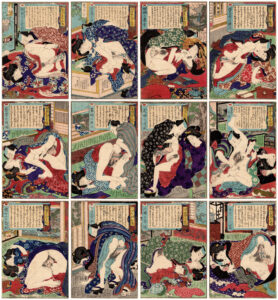
Almost every major master of Japanese woodblock printing, including Kitagawa Utamaro, Katsushika Hokusai, and Utagawa Kunisada, dedicated a substantial portion of his career to designing shunga. Far from being a marginal sideline, erotic prints represented a central, prestigious, and commercially vital branch of Edo-period (1603–1867) visual culture.
Modern viewers sometimes assume that explicit imagery stood outside mainstream art history, yet in pre-modern Japan the boundary between refined aesthetics and sensual representation did not exist in the same way. Understanding why leading ukiyo-e artists produced shunga requires looking at the economic structure of Edo publishing, artistic ambition, and the social role of erotic prints.
Commercial Demand and Publisher Economics
Woodblock print production in Edo (modern Tokyo) operated as a commercial enterprise driven by market demand. Publishers financed every project and commissioned top designers whose names guaranteed strong sales across urban bookshops and lending libraries (kashihon’ya).
Because shunga albums and sheet prints commanded high prices and sold reliably across all social classes, publishers actively sought out the finest artists, carvers, and printers. Deluxe multi-color nishiki-e editions often featured expensive mineral pigments, metallic mica, and blind embossing (karazuri), making them some of the most lucrative commissions available to an ukiyo-e master.
Artistic Mastery and Technical Innovation
For ambitious printmakers, shunga offered an unmatched arena to demonstrate technical virtuosity. Depicting intertwined figures required complex anatomical foreshortening, expressive facial nuance, and intricate layering of patterned kimonos and interior architecture.
Artists used shunga to experiment with bold compositions and delicate printing effects that later influenced their landscape and beauty prints (bijin-ga). Masters such as Keisai Eisen, Kikukawa Eizan, and Utagawa Kunisada treated erotic albums with the same compositional rigor they applied to theatrical portraits and literary illustrations.
Social Acceptance and Cultural Context
Throughout the Edo period, sexuality was widely viewed as a natural aspect of human life rather than a moral taboo. Although the Tokugawa shogunate issued periodic sumptuary edicts—most notably during the Kansei Reforms of 1790 and the Tenpo Reforms of 1842—enforcement remained inconsistent.
To bypass official restrictions, artists simply omitted their formal signatures or signed with playful pseudonyms while retaining their unmistakable personal styles. Collectors immediately recognized the hand of a celebrated master, and shunga continued to circulate openly as wedding gifts, collector treasures, and artistic showcases.